Switching from Hospitality to Office Work: How to Pivot with No Experience?
Switching from hospitality to office work means translating years of real, demanding experience into a language that office employers and their software can actually read. You have spent years reading a table of twelve guests, remembering who ordered the allergy substitution, calming the kitchen during a Saturday rush, and still smiling when the check arrived. That is not "just waitressing." That is a skill set. The problem is that when you try to move from hospitality to an office role, the Applicant Tracking System (ATS), the algorithm that scores your resume before any recruiter touches it, does not recognize your experience because the words you used to describe it do not match the words in the job posting.
This is not about your qualifications. The system filters on vocabulary, not on competence. And that is fixable.
Your Documents Are Disappearing Into a Black Hole
You send the application. You wait. You check your inbox. Nothing. You send another one. Nothing again. After a few weeks of this, the silence starts to feel personal.
It is not personal. What is happening is mechanical: the recruiter's ATS ranks hundreds of resumes against the keywords in the posting, and only the top results get a human look. When you describe your hospitality experience using hospitality language, "served tables," "managed floor," "handled guest requests," the algorithm does not connect those phrases to what an office job posting calls "customer relationship management," "time management," or "conflict resolution." Your resume is good. The system just does not see the translation.
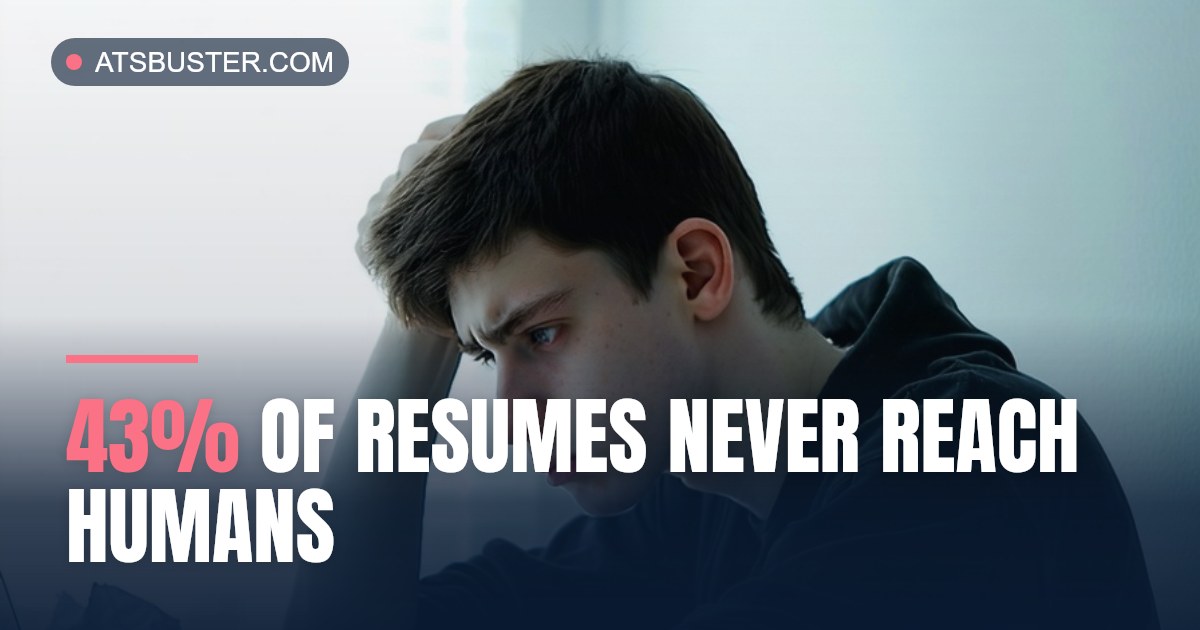
According to EDLIGO's analysis of 1,000 resumes, 43% of rejections come from formatting or parsing errors, not from a lack of qualifications (EDLIGO, 2025). That means nearly half the people filtered out were perfectly capable of doing the job.
You are probably one of them.
3 Invisible Errors That Block Your File
Before you rewrite a single bullet point, check whether your resume is even readable by the ATS. These three problems stop candidates before a human ever gets involved:
- Graphic or multi-column templates - the ATS parsing accuracy drops sharply when it encounters columns, text boxes, or decorative layouts
- Hospitality job titles with no keyword bridge - phrases like "floor supervisor" or "front-of-house lead" do not map to office equivalents unless you spell out the connection
- Inconsistent section formatting - if your work experience section uses a non-standard label or unusual date format, the system may skip it entirely
A plain, single-column document with standard section headers is not boring. It is the format that actually gets read.
How to Turn Hospitality Experience Into Office-Ready Assets
Here is the honest truth about switching careers from hospitality to office work: you already have most of what office employers want. The gap is not in your abilities. The gap is in how your resume names those abilities.
Think about what you actually did every shift. You managed multiple tasks simultaneously under time pressure. You resolved complaints from difficult customers without escalating the situation. You coordinated with a team across different roles, kitchen, front-of-house, management, to deliver a result on a hard deadline. You tracked orders, payments, and special requests without letting anything fall through.
In office language, that reads as:
- Multitasking under deadline pressure
- Customer relationship management and conflict de-escalation
- Cross-functional team coordination
- Process tracking and attention to detail
- Time management in high-volume environments
The technique here is rebranding, not exaggerating. "Managed guest experience for 80-cover restaurant during peak service" is a truthful, office-readable version of "served tables on weekends." You are not inventing skills. You are translating them into the vocabulary the ATS is looking for.
The challenge is knowing which exact keywords appear in the specific posting you are applying to. That changes from company to company, from role to role. A customer service coordinator posting at a logistics firm uses different language than the same role at a software company. Manually hunting for those keywords across every application is exhausting, especially after a full shift on your feet.
Start rebranding your experience with ATS Buster - it compares your resume to the specific posting and rewrites it with the keywords that posting is actually using.
Let Technology Do the Translation Work
Manually tailoring your resume for every single application is not a strategy. It is a second job, and it burns people out fast. After eight hours of work, sitting down to carefully rewrite your experience section for the fourteenth time this month is how a career change stalls out.
ATS Buster approaches this differently. You paste in your current resume and the job posting you want to apply for. ATS Buster compares your resume against the specific posting, identifies missing keywords, and rewrites your experience descriptions to match the employer's language, all in about a minute. It also generates a cover letter and exports a clean PDF.
This matters for career changers in particular, because the keyword gap between hospitality and office work is real and consistent. ATS Buster closes that gap automatically, without you having to guess what the algorithm is looking for.
Here is what the process replaces:
- Spending an hour manually reading a job posting for keyword patterns
- Rewriting your experience section from scratch for each application
- Wondering whether the formatting you chose will survive the ATS parse
- Sending a resume that sounds like a hospitality worker instead of an office candidate
Every application you send without addressing the keyword gap has the same outcome as the last one. Create a free account and use your 3 free credits to tailor your first application, no credit card needed.
Take Back Control of Your Career Change
Switching industries without prior office experience feels like a catch-22: you cannot get the job without experience, but you cannot get experience without the job. The way out of that loop is not more applications. It is better-translated applications.
You do not need years of office history to compete for entry-level and coordinator roles. You need a resume that speaks the language of the posting. Your hospitality background, the pressure, the people skills, the operational coordination, is genuinely valuable in office environments. The only thing standing between you and a callback is whether the ATS can read that value in the words you used.
Another blind application with the same untranslated resume will end the same way. The fix takes about a minute.
Frequently asked questions
Sources & references
- EDLIGO, 43% of rejections come from formatting, parsing, or arbitrary filters, analysis of 1,000 resumes, 2025
- EDLIGO, single-column resume format achieves 93% parsing accuracy vs 65% for multi-column layouts, 2025
- General industry estimate, 2025
Enjoyed the article?
Tailor your resume to a specific job in about a minute and get past the recruiter's filters.
Try ATS Buster