How to Write a CV as a Fresh Graduate: Your Career Starter Guide
You've just crossed the stage, diploma in hand, and suddenly the question that felt abstract for four years becomes very real: how do you write a CV as a fresh graduate when you have almost nothing to put on it? That blank page isn't a sign you've failed. It's a starting point that most successful professionals once faced too.
The good news: hiring managers who review entry-level applications already expect limited work history. What they're actually scanning for is potential, relevance, and clarity. Your job isn't to fake experience you don't have. It's to present what you do have in a language employers recognize.
Why Your CV Feels Like It's Disappearing Into Thin Air
Sending application after application and hearing nothing back is genuinely demoralizing. You start questioning your degree, your choices, your worth. Stop there, because this isn't about your qualifications. The entry-level job market has a structural problem: many companies now route every application through automated ranking systems before a recruiter ever opens a file. Your resume can be honest, thoughtful, and well-written, and still land nowhere near the top of the stack. That outcome is fixable.
The mindset shift that matters most: stop thinking of yourself as someone with "no experience" and start thinking of yourself as someone with untapped, transferable potential. Every project you shipped, every volunteer shift you pulled, every team presentation you led, those are real professional events. The only question is whether your CV translates them into terms an employer's system can recognize.
How to Describe Internships and Projects So They Sound Like Real Work
The biggest mistake fresh graduates make is describing what they did instead of what they delivered. "Assisted the marketing team" tells a recruiter nothing. "Helped run three email campaigns reaching 4,000 subscribers" tells them you can execute.
Use the STAR method, even for short experiences:
- Situation: briefly set the context (the company, the team, the challenge)
- Task: what you were responsible for
- Action: what you actually did, with specific tools or methods
- Result: a number, a percentage, a concrete outcome, or even qualitative feedback
When you can't attach a number, describe the scale or impact. "Organized a campus fundraiser for 200 attendees" is far stronger than "helped with event planning."
For the education section, lead with relevant coursework, thesis topics, and academic projects when your work history is thin. A capstone project in data analysis or a dissertation on consumer behavior is legitimate experience. Label it clearly, describe the methodology, and note any tools you used.
Here's what a weak and a strong entry-level bullet point look like side by side:
Weak example (gets lost in the stack):
Work experience: Internship at a marketing agency. Helped with various tasks and supported the team.
Why it fails: no keywords, no numbers, no specificity.
Strong example (gets noticed):
Marketing Intern, Digital Agency, Summer 2024 - Drafted social media content for 5 client accounts, growing combined engagement by 18% - Assisted in keyword research for 3 SEO campaigns using Google Search Console and Semrush - Presented weekly performance reports to a team of 6
Why it works: specific tools, specific numbers, action verbs throughout.
Soft skills matter too, but only when you translate them into business value. "Strong communicator" means nothing. "Presented research findings to a panel of 12 faculty members and incorporated feedback to revise the final report" means something.
Why Your Documents Are Falling Into an Information Black Hole
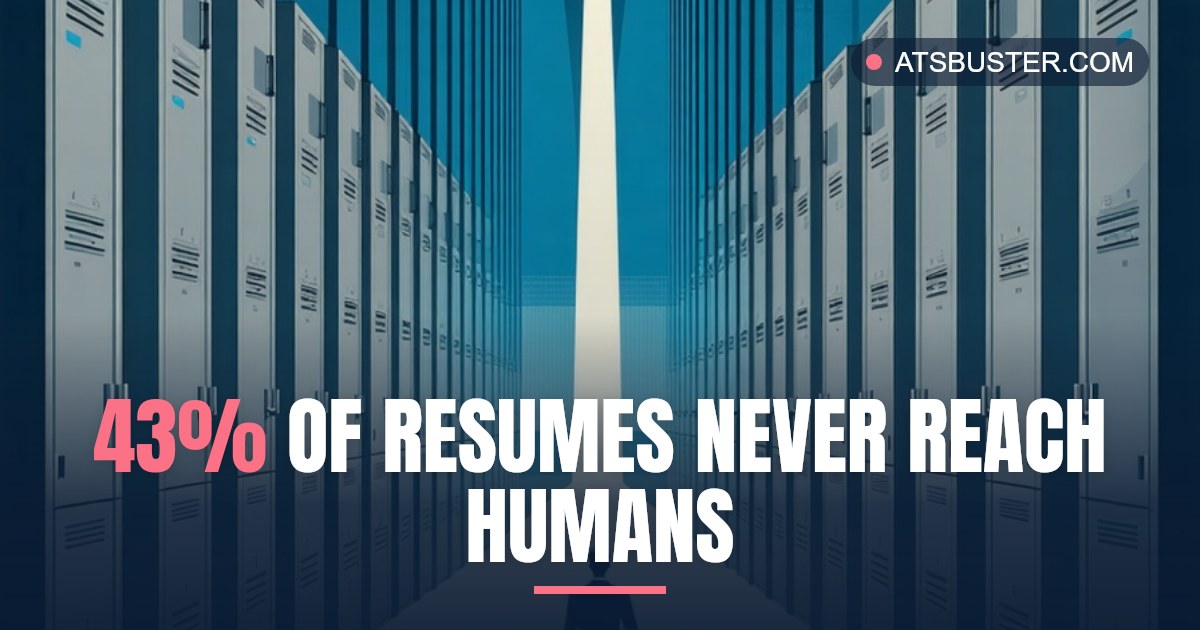
Here's something most first-time job seekers don't know: your CV might never reach human eyes at all. Many companies, including mid-sized firms with fewer than 500 employees, now use applicant tracking systems to rank applications before a recruiter reviews them. According to EDLIGO's analysis of 1,000 resumes (2025), 43% of rejections happen for technical reasons before a recruiter ever sees the file. Not because the candidate was underqualified. Because the document failed a formatting or keyword test.
This matters especially for fresh graduates, who often spend hours crafting a visually polished CV with columns, icons, and creative layouts, only to have it parsed as gibberish by the ranking software.
3 invisible errors that cause the system to block your file
- Tables and multi-column layouts: the ranking system reads left-to-right in a single pass; columns cause it to scramble your text or skip it entirely (EDLIGO, 2025)
- Generic skill labels: writing "good communication skills" instead of mirroring the exact phrasing from the job posting means the system scores you lower on relevance
- Image-based PDFs: if your CV was saved as a scanned image rather than text, the system reads zero words from it
The fix for all three is simpler than it sounds: use a clean, single-column layout, save as a text-based PDF, and read the job posting carefully enough to echo its exact language back.
Stop Wasting Hours on Manual Edits That Go Nowhere
Manually tailoring your CV to every single job posting is exhausting work. You read the posting, identify keywords, rewrite bullet points, adjust the summary, reformat the file, and repeat for the next one. Multiply that by 30 applications and you've spent a full work week on documents that may still miss the mark.
The problem with manual tailoring isn't effort. It's precision. Job postings are written by different people with different vocabularies. One company says "project management," another says "cross-functional coordination." Both mean roughly the same thing, but the ranking system treats them as different signals. Catching every variation by hand is nearly impossible.
This is exactly where ATS Buster changes the equation. ATS Buster takes your existing CV, compares it against the specific job posting you're targeting, rewrites it to fill in the missing keywords, and returns a clean, ATS-readable document in about a minute. It also generates a matching cover letter and exports everything as a properly formatted PDF. You're not guessing what the system wants. ATS Buster maps your actual experience to the posting's requirements and closes the gap.
For a fresh graduate, this is particularly valuable. You may have the right skills from coursework and internships, but lack the industry vocabulary to express them the way a job posting expects. ATS Buster bridges that translation problem automatically.
Create a free account at ATS Buster and use your first three credits to tailor your CV to the roles you care most about. No credit card required.
Your First Job Starts with the Right Match
Waiting passively for replies is a strategy that rarely works. The candidates who land interviews aren't always the most qualified. They're the ones whose CVs speak the employer's language clearly enough to clear the first filter and reach a recruiter's screen.
As a fresh graduate, you have more to offer than you think. The gap isn't experience. It's presentation. A well-structured CV that mirrors the language of the posting, avoids formatting errors, and highlights real deliverables from your studies and internships can outperform a sloppy CV from someone with twice the experience.
ATS Buster helps you get that presentation right without spending hours on every application. Three free credits, no credit card, your tailored CV ready in about a minute. Start here and send your next application with confidence.
Frequently asked questions
Sources & references
- EDLIGO, 1000-resume analysis, 2025
- Enhancv, survey of 25 US recruiters, 2025
- General industry estimate, 2025
Enjoyed the article?
Tailor your resume to a specific job in about a minute and get past the recruiter's filters.
Try ATS Buster