Job Market 2026: What Awaits Employees in the Coming Months?
The global job market in 2026 is not broken. It is being rebuilt, faster than most workers expected, and the rules that worked three years ago no longer apply. If you have been sending applications and hearing nothing back, that silence is not a verdict on your abilities. It is a signal that the hiring infrastructure has changed underneath you, and that catching up requires understanding what is actually shifting, not just working harder at the same approach.
Why You Feel Stuck: The Real Shape of Hiring Right Now
The job market trends for 2026 are defined by one central tension: more roles are opening globally, but the path to getting hired has become technically harder to navigate. The World Economic Forum's Future of Jobs Report 2025 projects a net gain of 78 million new jobs by 2030, with 170 million roles created and 92 million displaced. Growth is real. The friction is also real.
That friction comes from two places. First, more candidates are applying to every opening because remote work removed geographic barriers. Second, companies responded to that volume by automating more of the initial screening. The result: your application now passes through more layers before a human reads it. This is not about your qualifications. The screening infrastructure became more restrictive because of volume, not because candidates got worse.
✓ What this means for you: The market is not closing. The entry point moved. Understanding where it moved is the first step to getting through it.
Which Roles Are Growing in 2026?
The clearest growth is happening where digital skills and human judgment intersect. Employers are not simply hiring "tech people" or "people people" anymore. They want both in the same person.
Roles gaining ground across industries right now:
- AI-adjacent operations - project managers and analysts who can work alongside automated systems
- Healthcare and care work - aging populations are driving sustained demand globally
- Cybersecurity - every organization that digitized in 2020-2022 now needs to protect what it built
- Green energy and sustainability roles - infrastructure investment is translating into hiring
- Customer experience with technical depth - support and success roles that require both empathy and product knowledge
- Data literacy in non-tech functions - finance, marketing, and HR teams need people who can read a dashboard and act on it
The common thread is hybrid competency. A marketing analyst who understands automation tools is more valuable than a pure analyst or a pure technologist. A nurse who can navigate digital health records and communicate clearly with patients is in higher demand than one who excels at only one of those things.
The World Economic Forum estimates that 39% of core worker skills will change by 2030. That figure is actually an improvement from the 44% projected in 2023, meaning the pace of disruption is slightly slower than feared. But 39% is still enormous. If you have not updated your skill set in the last two years, some of what you list on your resume may already read as dated to a recruiter.
Why Your Applications Disappear
Here is the part nobody explains clearly. You apply. You meet the requirements. You hear nothing. Weeks pass.
The silence is not random. Most mid-sized and large employers now use automated ranking systems to manage application volume. These systems do not read your resume the way a person does. They scan for specific terms, compare them against the job posting, and assign a score. Resumes that score below a threshold get buried. The recruiter reviewing the stack often sees only the top candidates, and everyone else simply does not exist in their workflow.
This is not a conspiracy. It is a volume problem. A single posting for a project manager role at a company with a recognizable name can attract 180 or more applications in 48 hours. No recruiter can read all of them. The ranking system is their triage tool.
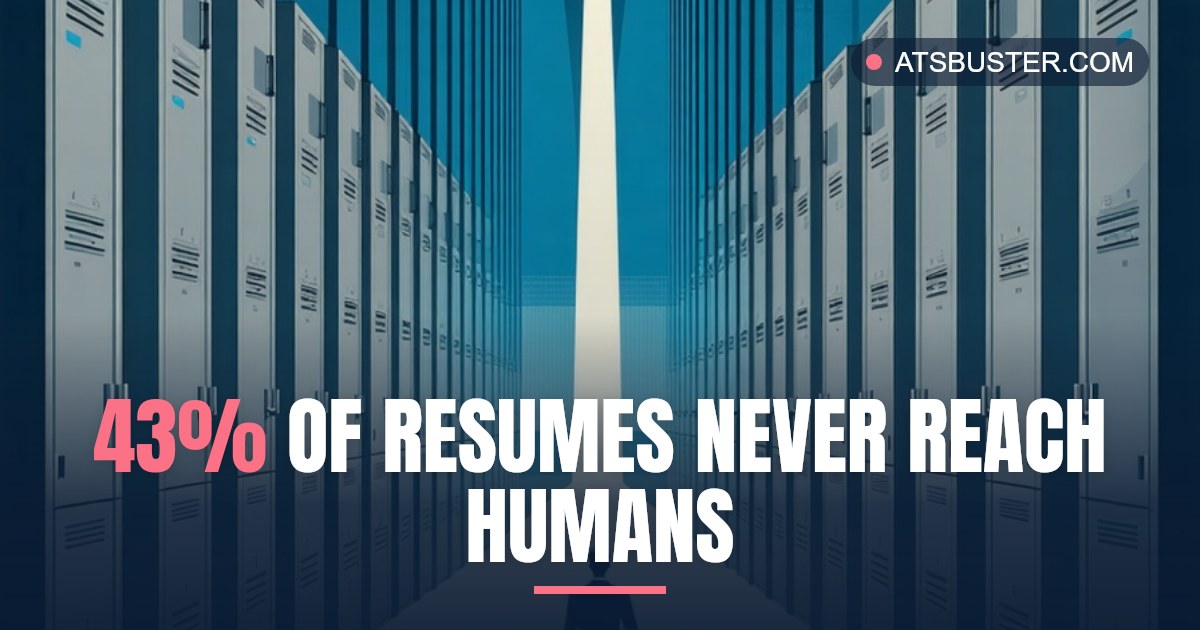
43% of application rejections are caused by formatting and parsing errors, not by lack of qualifications (EDLIGO, 2025). Your resume might be excellent, but if the system cannot read it correctly, it scores as if it were blank.
3 Invisible Errors That Block Your Resume Before Anyone Reads It
These are the mistakes that cost candidates interviews without them ever knowing:
- Tables and multi-column layouts - automated systems often misread these, scrambling your job titles and dates
- Missing keywords from the specific posting - a resume written for "project management" may score low on a posting that uses "program delivery" and "stakeholder alignment"
- Terminology mismatches - you write "led a team of 8," the posting requires "people management experience"; the system may not connect them
None of these are about your actual ability to do the job. They are translation problems between how you describe your experience and how the system is programmed to find it.
⚠ Most common mistake: Sending the same resume to every opening. Each posting uses a different vocabulary. A generic resume consistently scores below tailored ones, regardless of your qualifications.
Taking Back Control: What You Can Actually Do
Manual tailoring works. Read the posting carefully, identify the key phrases, rewrite your bullet points to reflect them, adjust your summary. Do that for every application. It takes 45 minutes to an hour per resume, done properly.
If you are applying to 20 or 30 positions, that is 30 to 50 hours of work before you get a single interview. Most people either skip the tailoring (and wonder why they hear nothing) or burn out doing it and stop applying altogether.
This is where ATS Buster enters the picture. ATS Buster takes your existing resume and the text of a specific job posting, compares them, rewrites your resume to match the posting's language and requirements, and returns a finished, ATS-readable document in about a minute. It fills in the keywords you are missing, restructures the content to reflect the posting's priorities, and exports a clean PDF. It also generates a cover letter for the same posting.
The point is not to fake qualifications you do not have. The point is to make sure the system can actually see the qualifications you do have, described in the language the posting is looking for.
ATS Buster does not just flag what is missing and leave the work to you. It rewrites the resume. That distinction matters because the problem is not awareness, it is time. Most candidates already know their resume could be better tailored. The gap is between knowing and doing it 30 times.
You can start with a free account, 3 free credits, no credit card required. Tailor your first resume to a real posting and see the difference in how the document reads.
Another application sent without tailoring will produce the same result it has been producing. That is not pessimism. It is just how the current system works, and knowing that is the first step to working around it.
Frequently asked questions
Sources & references
Enjoyed the article?
Tailor your resume to a specific job in about a minute and get past the recruiter's filters.
Try ATS Buster