Career in Logistics: Salary, Requirements, and Outlook for 2026
Logistics jobs -- covering salary expectations and entry requirements -- are among the most searched career topics heading into 2026, and for good reason. Logistics is one of the few industries where demand for workers has quietly outpaced supply for years, and 2026 looks no different. If you are exploring a career in logistics for the first time, or wondering whether your experience translates into better pay, the picture is more encouraging than most job boards suggest. The global economy runs on supply chains, and the people who manage them are not optional.
Why Logistics Is One of the Safest Career Bets Right Now
The sector covers a wide range of roles: warehouse operations, freight forwarding, last-mile delivery coordination, customs compliance, procurement, and supply chain analysis. That breadth is a feature, not a complication. It means there are entry points at almost every skill level, and clear paths upward once you're inside.
The World Economic Forum's Future of Jobs Report 2025 projects a net gain of 78 million jobs globally by 2030. Supply chain and logistics roles sit firmly in the growth column, driven by e-commerce expansion, nearshoring trends, and the ongoing complexity of global trade. That's not a forecast to dismiss.
People sometimes assume that warehouse and transport work is being automated away. Some tasks are. But coordination, exception handling, vendor management, and cross-border compliance require human judgment that automation has not replaced. The roles are evolving, not disappearing.
There is one frustration that's nearly universal in this field: you apply for a position you're clearly qualified for, and nothing happens. No rejection, no callback, just silence. That silence is rarely about your qualifications. Hiring systems at mid-size and large companies filter applications before a recruiter ever opens them, and a well-written resume can still fail that filter for purely technical reasons. This isn't about your experience. The system ranks applications by keyword match, and if your resume doesn't mirror the language in the posting, it sinks to the bottom of the stack. That's fixable.
Realistic Salaries and Requirements: What to Know Before You Apply
Compensation in logistics varies significantly by role, region, and whether you're working in operations or management. Here's a practical breakdown for 2026:
- Warehouse associate / logistics coordinator - entry level in the US typically ranges from $38,000 to $52,000 annually, with overtime common in peak seasons.
- Freight dispatcher / transport planner - mid-level roles generally land between $50,000 and $72,000 depending on the volume and complexity of routes managed.
- Supply chain analyst - typically $60,000 to $90,000, with higher figures for those fluent in data tools like SAP, Oracle TMS, or Power BI.
- Logistics manager / operations manager - $80,000 to $120,000+, with bonuses tied to efficiency metrics.
- Customs broker / compliance specialist - $55,000 to $85,000, often requiring a license or certification.
What do recruiters actually want to see? For most operational roles, the following carry real weight:
- Experience with warehouse management systems (WMS) or transport management systems (TMS)
- Familiarity with inventory control methods (FIFO, LIFO, cycle counts)
- A clean driving record for transport-adjacent roles
- Basic Excel or data analysis skills for coordinator and analyst positions
- Forklift certification for warehouse floor work
Breaking in without prior experience is entirely possible. Many companies hire for warehouse associate and dispatch support roles with minimal requirements, then promote internally. Staffing agencies that specialize in logistics are a practical first step. Certifications from APICS (Certified in Logistics, Transportation and Distribution) or the Chartered Institute of Logistics and Transport add credibility fast and cost far less than a degree.
The honest answer to "is logistics a good industry to enter?" is yes, with one caveat: the application process is where most candidates lose, not the interview.
3 Invisible Reasons Your Application Gets Buried
You can have the right certifications, the right experience, and a clean resume, and still hear nothing. The problem is often structural, not personal.
Most companies with more than 50 employees now use applicant tracking systems to manage the volume of incoming applications. These systems don't read your resume the way a human does. They parse text, extract keywords, and score your application against the requirements in the job posting. A resume that scores below a threshold may never reach a human reviewer.
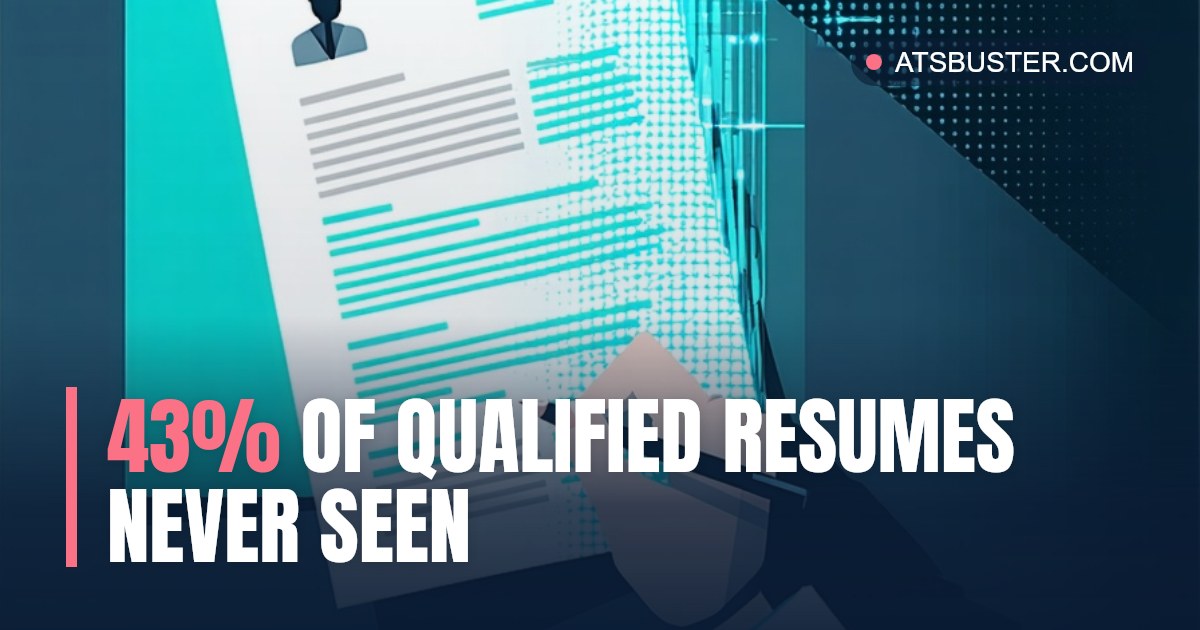
43% of application rejections trace back to formatting, parsing errors, or keyword mismatches rather than lack of qualifications (EDLIGO, 2025). That's nearly half of all filtered-out candidates who were, on paper, qualified.
Here are the three most common technical reasons a logistics resume gets buried:
- Wrong keywords - you write "stock management" but the posting says "inventory control." Both mean the same thing. The system doesn't make that connection.
- Two-column or table-based layouts - visually clean to a human eye, but many ATS parsers misread columns and scramble your work history entirely.
- Generic resume sent to every posting - each company's system is calibrated to its own job description. A resume that scores well for one opening may score poorly for a nearly identical role at a different company.
None of these errors reflect your ability to do the job. They reflect a mismatch between how you wrote your resume and how a parsing algorithm reads it.
⚠ The most common mistake in logistics applications: Sending one resume to 30 different warehouse, dispatch, and coordinator roles. Each posting uses different terminology. A generic resume hits the bottom of the stack every time. ✓ What actually works: Matching the specific language in each posting. Not all keywords, just the 4-5 most prominent ones in the requirements section.
Take Control: How ATS Buster Changes Your Odds
Manually rewriting your resume for every application is genuinely exhausting. Most people do it once or twice, then give up and send the same version everywhere. That's understandable, but it's also why the silence keeps coming.
ATS Buster is an AI tool that tailors your resume to a specific job posting in about a minute. You paste in the job description, upload your existing resume, and ATS Buster rewrites it to match the posting's language, fills in the keywords your current version is missing, and returns a finished, ATS-readable document. It also generates a cover letter and exports an ATS-friendly PDF you can submit immediately.
This is not a passive scanner that tells you what's wrong and leaves you to fix it. ATS Buster does the rewriting for you, based on the actual requirements in the posting you're targeting.
For a logistics job search, this matters more than it might in other fields. Job titles overlap ("logistics coordinator" vs. "supply chain coordinator" vs. "operations coordinator") and each company phrases its requirements differently. ATS Buster maps your real experience to the exact language each employer uses.
Create a free account at ATS Buster and tailor your resume to the next logistics role you're targeting. You get 3 free credits to start, no credit card required.
The job market in logistics is genuinely strong. The barrier is rarely your qualifications. It's getting your application in front of a human who can see that.
Check the pricing page if you're planning to apply to multiple roles simultaneously. Three tailored resumes is a reasonable test to see how your response rate changes.
Frequently asked questions
Sources & references
- World Economic Forum, Future of Jobs Report 2025
- EDLIGO, analysis of 1,000 resumes, 2025 - 43% of rejections attributed to formatting, parsing errors, or keyword mismatches
Enjoyed the article?
Tailor your resume to a specific job in about a minute and get past the recruiter's filters.
Try ATS Buster