Transferable Skills: How to Highlight Them in Your CV
Transferable skills are the abilities you carry from one industry into another, and they are genuinely valuable to any employer. You spent a decade building real expertise. You led teams, solved hard problems, and delivered results. Now you're applying to roles in a new field, and the silence from recruiters feels like your entire career just got erased. It hasn't. The problem isn't your experience. The issue is that the system filtering your resume doesn't speak your old industry's language, and your CV hasn't been translated yet.
Why Your Years of Work Feel Invisible
Changing industries triggers a specific kind of dread: the fear that everything you've built no longer counts. That feeling is real, and it's also wrong. What's actually happening is a translation problem, not a qualification problem.
Most companies today route applications through an Applicant Tracking System (ATS) before a recruiter ever opens a file. The ATS doesn't evaluate your judgment, your leadership, or your ability to learn fast. It scans for specific words from the job posting. If your resume uses the vocabulary of your old industry instead of the language of the new one, the system pushes your file to the bottom of the stack, regardless of how strong your background actually is.
This isn't about your qualifications. The ATS filtering mechanism causes qualified candidates to disappear before any human reviews them. And it's fixable.
Your Experience Is a Hidden Asset the Algorithm Can't See Yet
Transferable skills are competencies that apply across industries and roles: things like project management, stakeholder communication, data analysis, budget oversight, and coaching. A nurse who managed shift schedules and patient triage has operational coordination skills that map directly onto logistics or operations roles. A teacher who designed curriculum and tracked student outcomes has project planning and performance measurement experience that translates cleanly into HR or learning and development.
The gap isn't in what you've done. The gap is in how your resume describes it.
When you use the terminology of your previous field, an ATS built to screen for a different industry's vocabulary simply doesn't find a match. Your resume isn't weak. It's speaking the wrong dialect. Mapping your competencies to the language of the target role is how you make the algorithm see what's already there.
3 Invisible Errors That Get Your Resume Filtered Out
Career changers tend to make the same three mistakes without realizing it, and each one quietly kills an application:
- Industry jargon from your old field instead of the keywords used in the job posting (the ATS is tuned to the posting's language, not your previous sector's)
- Tables and multi-column layouts that ATS parsers can't read correctly, causing your experience section to appear blank or scrambled
- Generic role descriptions that list responsibilities instead of outcomes, giving the algorithm nothing measurable to match against
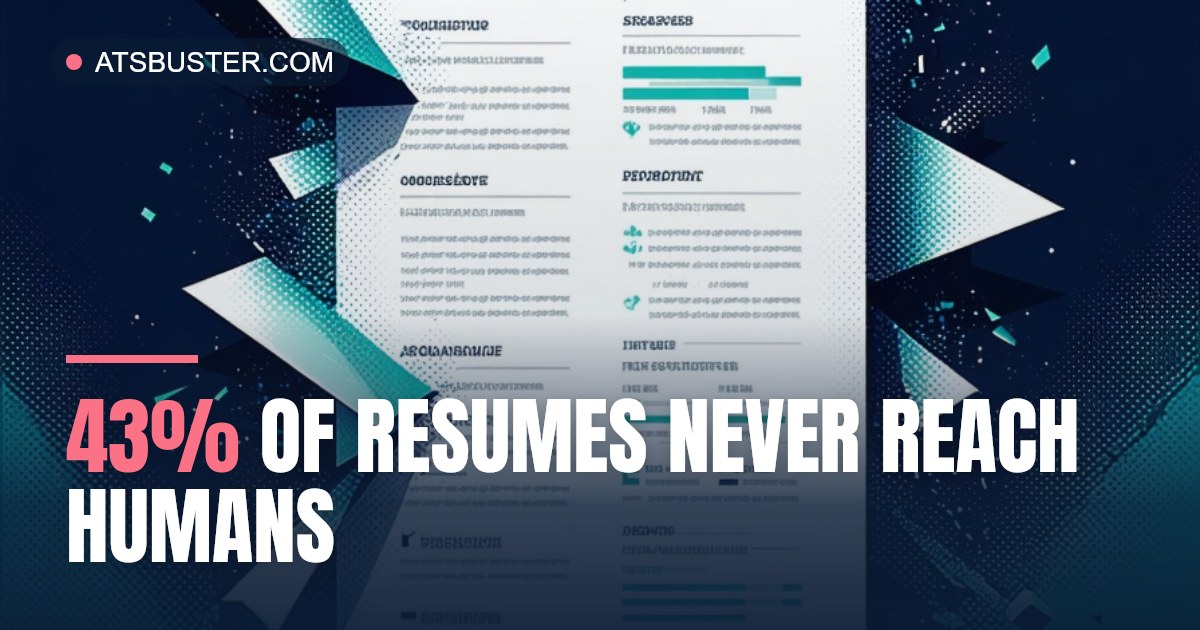
According to an analysis by EDLIGO (2025), 43% of rejections are caused by formatting, parsing errors, or mismatched vocabulary, not by a lack of qualifications. That means nearly half the candidates filtered out could have passed if their documents had been structured differently.
The recruiter never gets the chance to disagree with the algorithm. By the time a human looks at the shortlist, your file is already gone.
Why Manually Rewriting Your Resume for Every Job Is Unsustainable
The obvious solution sounds simple: read each job posting carefully, identify the keywords, and rewrite your resume to match. In practice, that process takes two to four hours per application when done properly. You have to parse the posting, map your skills to its language, rewrite bullet points, check formatting, and export a clean file.
If you're applying to twenty roles, that's potentially eighty hours of work. Most of it is repetitive. All of it is mentally exhausting. And after each round, you still don't know whether the document will parse correctly on the other end.
The psychological cost compounds quickly. Every rewrite that produces no response adds to a growing sense that the effort itself is pointless. That's not weakness. That's a rational response to a broken feedback loop.
Here's what makes it worse:
- You can't see how the ATS actually reads your file
- You don't know which keywords the specific system is weighted toward
- You can't tell whether your formatting survived the parse
- You're guessing at what "matches" means for each individual posting
Manual optimization isn't a strategy. It's a lottery with a lot of ticket-buying and no visible odds.
Automate the Translation and Get Your Applications Working
This is where ATS Buster changes the equation. Instead of spending hours manually cross-referencing your resume against a posting, ATS Buster tailors your entire resume to the specific job in about a minute. It compares your existing experience to the posting's requirements, identifies the skills you have that aren't yet expressed in the right language, and rewrites the document with the keywords and structure the ATS is looking for.
It also generates a cover letter matched to the same posting and exports an ATS-readable PDF, so the file that reaches the system is clean and correctly formatted.
The loss here is concrete: every application you send with an unoptimized resume is a real opportunity that disappears before a human sees it. The experience you've spent years building gets filtered out in half a second because three phrases from the posting aren't on the page.
You can create a free account at ATS Buster and use 3 free credits to see exactly how your resume maps against a real posting, no credit card required. The first tailored version takes about a minute to generate.
How to Transfer Your Competencies Without Starting from Scratch
ATS Buster works by reading the language of the specific posting and then finding where your existing experience already matches, even when the terminology differs. A background in client-facing sales maps to "stakeholder management" in a project management role. Experience running training sessions maps to "facilitation" or "L&D coordination" in an HR posting. The skills are already there. ATS Buster surfaces them in the vocabulary the target role actually uses.
This is why career changers benefit more from this approach than almost any other candidate type. Your resume isn't missing content. It's missing translation. According to the World Economic Forum's Future of Jobs Report 2025, 39% of core employee skills are expected to shift by 2030, meaning cross-industry movement is becoming the norm, not the exception. The hiring systems haven't caught up to that reality. ATS Buster bridges that gap.
Register for free and generate a professionally tailored resume that reflects everything you've actually built. Three credits, no credit card, your matched CV in about a minute.
Frequently asked questions
Sources & references
- EDLIGO, analysis of 1,000 resumes, 2025
- World Economic Forum, Future of Jobs Report 2025
Enjoyed the article?
Tailor your resume to a specific job in about a minute and get past the recruiter's filters.
Try ATS Buster