Job Interview With No Experience: How to Impress Recruiters
Walking into a job interview when you have little or no work history feels like showing up to a math exam without a calculator. Knowing what to say in a job interview when you have no experience is one of the most common challenges for first-time candidates. You know you're capable, but the gap between what you've done and what the job description demands looks enormous. Here's the thing: recruiters interviewing candidates with no experience are not expecting a polished ten-year career story. They're looking for something harder to fake and easier to develop than experience itself.
No Experience Is Not a Disqualifier. Here's Why.
The stress of a job interview with no experience is real, but it's a mental challenge, not a reflection of your value. Most first-time candidates walk in believing the recruiter wants a track record. What the recruiter actually wants is evidence that you can learn, contribute, and show up with the right attitude.
That shift in perspective matters enormously. Think about what you've actually done: group projects at school, a volunteer role at a local shelter, helping a family member run a small business, a side project you built because you were curious. None of these sit on a formal payslip. All of them produced real, transferable skills.
Transferable skills are the bridge between your life so far and the job you want. Consider what they look like in practice:
- Communication - presenting a group project to a class of 30 people
- Problem-solving - debugging a personal coding project at 2 a.m.
- Reliability - showing up every Saturday for a year to coach youth football
- Collaboration - coordinating five people toward a shared deadline with no authority to enforce it
When you frame your experience this way, you stop apologizing for what you lack and start translating what you have into the language the recruiter already speaks.
3 Techniques That Build Your Credibility With a Recruiter
1. Use the STAR method for real-life situations
STAR stands for Situation, Task, Action, Result. Most candidates think it only applies to corporate war stories. It doesn't. A recruiter asking "tell me about a time you solved a difficult problem" is perfectly happy to hear about a university group project that nearly fell apart, the specific thing you did to save it, and the outcome.
The key is specificity. "I helped my team" tells the recruiter nothing. "Our team had three conflicting approaches to the final presentation. I proposed we prototype all three in 20-minute blocks and vote on the strongest one. We finished on time and got the highest mark in the cohort" tells them everything they need.
2. Honesty beats bluffing every time
When a recruiter asks about something you genuinely don't know, say so clearly, then show how you'd find out. "I haven't worked with that software directly, but I've taught myself three similar tools in the past and I'd prioritize getting up to speed in the first two weeks" is a better answer than a vague claim that unravels under a follow-up question.
Recruiters interview dozens of candidates. They can detect a bluff quickly. Honest self-awareness paired with visible enthusiasm is a combination that stands out precisely because most candidates try to hide their gaps instead of owning them.
3. Do the homework nobody else does
Before any interview, spend 30 minutes researching the company beyond its homepage. Read a recent press release, check their LinkedIn for announcements from the past three months, look at what their customers say in reviews. Then build one specific observation into your answers.
"I noticed you launched a new product line last quarter and I read a few customer reviews. It looks like onboarding is a common friction point. I've thought about how I'd approach that if I were in this role" is the kind of thing that makes a recruiter lean forward. It costs you half an hour. It signals more genuine interest than most experienced candidates bother to show.
Quick checklist before your interview: - Research one recent company development - Prepare two STAR stories from non-work situations - Write down one honest answer to "what don't you know yet?" - Prepare three questions that show you've thought about the role's real challenges
Why Your Resume Often Never Reaches a Human
Here's the part most candidates don't realize until they've already sent 40 applications. Before any recruiter reads your resume, an automated system ranks it against the job posting's language. This is called an Applicant Tracking System (ATS), and it's used by the vast majority of companies with any volume of hiring. The system doesn't reject your resume outright. It ranks it. If your resume doesn't reflect the specific words and phrases from the posting, it lands near the bottom of a stack the recruiter may never scroll to the end of.
This isn't about your qualifications. A formatting choice or a missing keyword causes the ranking to drop before any human makes a judgment. And it's fixable.
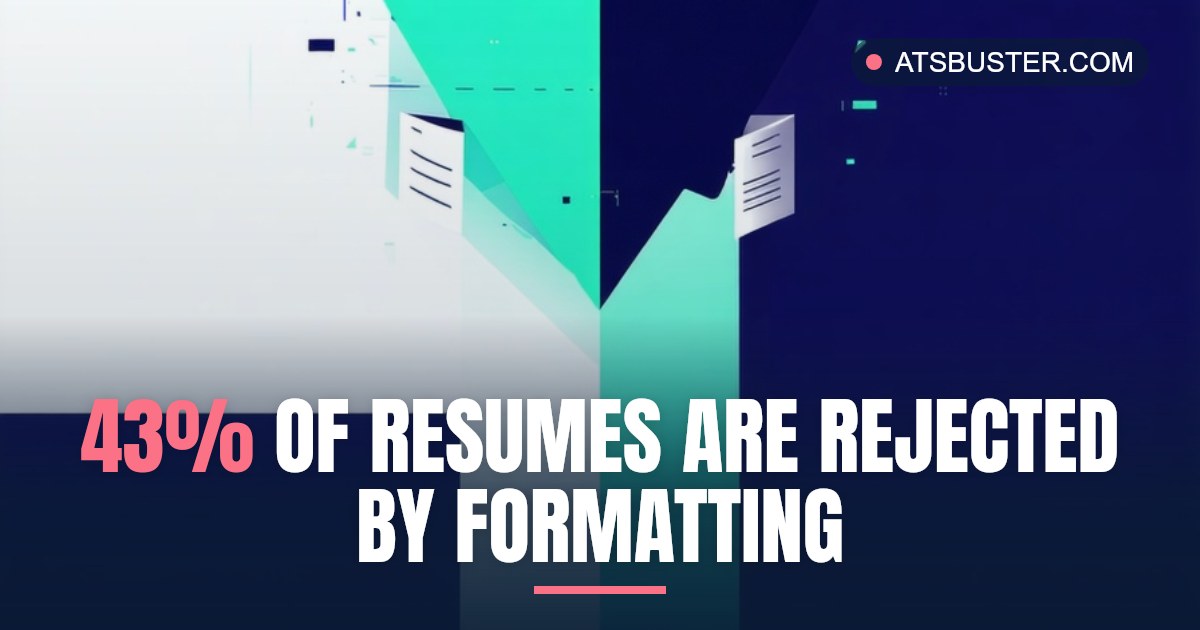
43% of resume rejections happen because of formatting or parsing errors, not because the candidate was underqualified (EDLIGO, 2025). That number is particularly painful for first-time job seekers, because you're already working harder to compensate for a thin work history, and then a two-column layout or an image-based PDF quietly buries your application before anyone reads a word.
The most common resume problems that sink first-time applicants:
- Two-column layouts - ATS parsers misread the order of information, mixing your name with your job title
- Tables and graphics - cause a significant share of parsing errors across all resume formats (EDLIGO, 2025)
- Generic language - "assisted with various tasks" matches no keyword in any posting
- Missing role-specific terms - a job posting that says "stakeholder communication" won't match a resume that says "talked to clients"
- Image-based PDFs - the system reads zero words from a scanned document
None of these are failures of intelligence or effort. They're technical mismatches between your document and a machine's parsing logic.
How to Automate Your Preparation and Stop Losing Before the Interview
Manually tailoring a resume to each job posting is exhausting work. You read the posting, identify the key phrases, figure out where they fit in your document, rewrite three sections, check the formatting, save a new version, and repeat for the next application. For a candidate with limited experience, this is even harder because you're simultaneously trying to frame thin history in the most relevant way possible.
This is where ATS Buster changes the equation. ATS Buster takes your existing resume and the specific job posting you're applying to, then rewrites and tailors the document to match the posting's language and requirements. It fills in the keywords your resume is missing, restructures the content for ATS readability, and generates a finished, ATS-friendly PDF. The whole process takes about a minute.
For a first-time job seeker, this matters more than it does for someone with ten years of experience. You need every application to work as hard as possible, because you can't compensate with a long track record. ATS Buster maps the language of the posting onto your actual experiences, including the transferable ones, so the recruiter's system sees a match instead of a gap.
Create a free account to try it. You get 3 free credits to start, no credit card needed.
The Steps That Break the Deadlock
The job search feels like a numbers game until you realize the numbers are working against you if your resume isn't optimized for each application. Thirty focused minutes per day with the right approach beats five hours of copy-pasting the same generic document into different portals.
Here's the practical rhythm that works:
- Find two or three job postings that genuinely fit your current skills and transferable experience
- Use ATS Buster to tailor your resume to each one specifically, not a generic version
- Spend the remaining time preparing your STAR stories and company research for the interviews you'll actually get
The goal is not to send as many applications as possible. The goal is to get interviews. A tailored resume that reaches a human recruiter is worth more than 20 generic ones that never leave the bottom of the stack.
Start optimizing your resume free and see exactly how your current document compares to the posting you want.
Frequently asked questions
Sources & references
- EDLIGO, 1000-resume analysis, 2025
- iHire, job market research, 2025
- SHRM, 2025 - Recruitment Is Broken
Enjoyed the article?
Tailor your resume to a specific job in about a minute and get past the recruiter's filters.
Try ATS Buster